
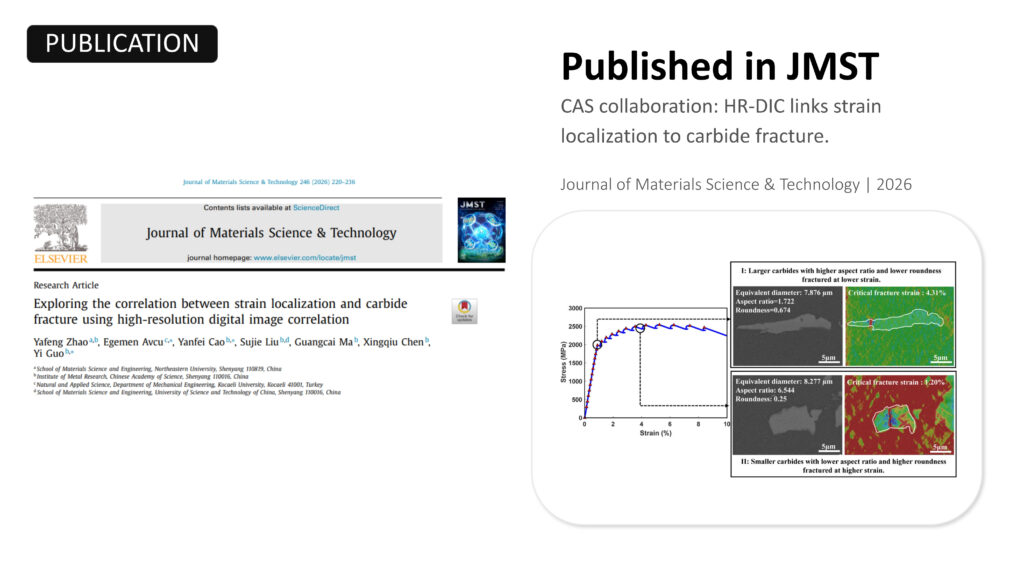
Article: Exploring the correlation between strain localization and carbide fracture using high-resolution digital image correlation.
Journal of Materials Science & Technology, Vol. 246 (2026) 220–236.
Authors: Yafeng Zhao, Egemen Avcu, Yanfei Cao, Sujie Liu, Guangcai Ma, Xingqiu Chen, Yi Guo.
Keywords: HRDIC, in-situ SEM, M50 bearing steel, strain localization, carbide fracture, microstructure-sensitive failure.
Glad to share the outcome of a truly rewarding scientific collaboration with Prof. Yi Guo (Institute of Metal Research, Chinese Academy of Sciences).
Our latest research has been published in the Journal of Materials Science & Technology.
I first met Prof. Guo in 2018 at the University of Manchester; since then, our professional connection has grown into a valuable long-term collaboration.
In this study, we combined high-resolution digital image correlation (HRDIC) with in-situ scanning electron microscopy (SEM) to quantify how local strain localization governs carbide fracture in M50 bearing steel.
By tracking deformation fields up to the moment of fracture, we identified four characteristic fracture types and linked each type to critical carbide features—such as size, aspect ratio, roundness, and pre-existing defects. These findings provide mechanistic insight into microstructure-sensitive failure and help interpret why nominally similar carbides can fracture at markedly different strain levels.
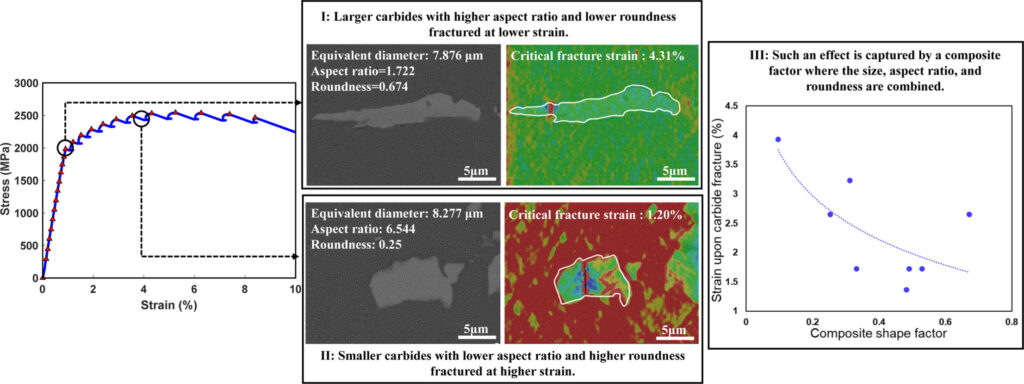
The graphical abstract (Figure 2) summarizes the core trend: smaller and rounder carbides tend to fracture at higher strain, whereas larger and more elongated carbides fracture earlier—captured quantitatively through a composite shape factor.
Key highlights
• HRDIC + in-situ SEM enables direct correlation between local strain hot spots and individual carbide fracture events.
• Four distinct carbide fracture types were distinguished and mapped to controlling microstructural attributes.
• Carbide geometry (size, aspect ratio, roundness) governs the critical fracture strain; pre-existing defects further reduce fracture strain.
• A composite shape factor provides a compact metric to capture the combined effect of carbide size/shape on fracture behavior.
Contact / Affiliation
Egemen Avcu – Natural and Applied Science, Department of Mechanical Engineering, Kocaeli University (Turkey)